PCB quality is the key to modern electronics, powering everything from smart phones to car applications. Any underlying fault can lead to costly product recalls or equipment downtime. That is why PCB inspection conveyor systems are an important part of manufacturing, guaranteeing every board meets tough quality controls.
I. Importance of PCB Inspection Conveyor in Electronics
- Attaining Zero-Defect Manufacturing
More than a mere transport function, a PCB inspection conveyor is the foundation for inspection through smooth board transportation from one production phase to another. Inspection conveyors are used to reduce defect rates up to 35% over manual transport by essentially minimizing scratches, dust contamination, or misalignment.
- Saving Time and Costs
A late-stage PCB defect can drive rework costs up to 400%. Having a reliable inspection conveyor at an earlier stage allows detection at an early time and lower cost. The result is enhanced yield, improved efficiency, and longer machine uptime on SMT lines.
II. PCB inspection conveyor belt working steps
A PCB inspection conveyor is designed to move circuit boards smoothly between production stages while allowing operators or machines to perform quality checks. The system ensures that every board meets the required standards before moving to the next process.
- Step 1: Board Transfer
The conveyor gently transports the PCB from one station to another using adjustable rails and belts. This prevents damage and keeps the board stable during inspection.
- Step 2: Visual or Automated Check
At the inspection point, workers or cameras carefully examine the board. They look for defects such as soldering errors, missing components, or alignment issues. Automated optical inspection systems are often combined with the conveyor to speed up the process.
- Step 3: Sorting and Decision
If the board passes inspection, the conveyor moves it forward for further assembly. If issues are found, the board can be diverted to a separate line for repair or manual rework. This step ensures that only qualified products continue in the production flow.
III. Key Features of a Modern PCB Inspection Conveyor
- Adjustable Width and Flexibility
Since PCBs may vary from 50 mm to 460 mm in width, adjustables conveyors ensure compatibility on a project-by-project basis. Hand cranks or motorized width adjustment allow for rapid changeovers with no production down time.
- Multi-Mode Operation
Current PCB inspection conveyor systems often involve modes like bypass, inspecting, or buffering. This allows operators to run boards continuously or halt them for close inspection.
- Smooth and Stable Transport
For protection against damage during inspection, conveyor structures feature stepper motors, strong frames, and anti-static belts. Reliable transport system reduces vibration and offers precise alignment during inspection.
IV. SZKJ’s modern PCB inspection conveyor belt
(1)Introduction to SZKJ Solution
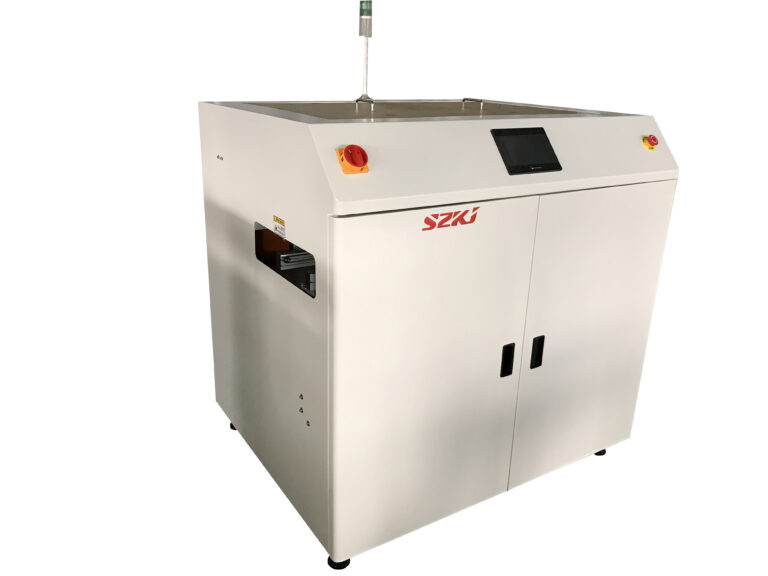
SZKJ, an established SMT equipment company, offers the NC-BC-460 PCB inspection conveyor as a reliable solution for companies seeking quality and versatility. The model features SMEMA compatibility for ease of integration into existing SMT production lines.

Key Features
- Panasonic PLC program control for utmost reliability.
- By-pass mode and inspection mode selectable to meet various workflows.
- Hand crank width adjustment for varying board sizes.
- Center PCB stop position for accurate alignment.
- Heavy bottom construction prevents movement during operation.
- Stepper motor conveyor drive to handle PCBs smoothly.
- Adjustable PCB flow direction to accommodate factory layouts.
- SMEMA interface for convenient interfacing with other SMT machines.
Optional Add-Ons
- Software-adjusted inspection intervals.
- Conveyor width adjustment by motor.
- Automatic width adjusting system.
- R485 communication follow-up system.
- Touch screen panel for easy operator access.
- Traceability using barcode scanning.
With these additions, the NC-BC-460 can minimal operator intervention and offer accuracy and reliability.
V. Practical Steps in PCB Inspection with Conveyor Support
- Visual and Optical Validation
Boards are centered on the PCB inspection conveyor during inspection to enable boards to be within reach of automated cameras and operators for validation of solder joints, polarity markings, and legibility of silkscreen.
- Integration of Electrical Testing
There are conveyors with points of in-circuit testing (ICT) integrated. Through stopping the board at set intervals, testers can employ probes to ensure electrical function before reflow or final assembly.
- Data Gathering and Feedback
Advanced inspection conveyors also have the ability to capture inspection data, including defect positions and types. For instance, smart-conveyor-based plants realize 20% reduction in defect trends for six months using real-time feedback loops.
VI. Trends in PCB Inspection Conveyor Technology
- Smart Automation
Modern PCB inspection conveyor systems use AI algorithms that learn to recognize defect patterns with increasing accuracy in every production cycle.
- IoT Connectivity
Modern conveyors integrate into factory IoT platforms, enabling real-time dashboards to monitor conveyor speed, board throughput, and inspection accuracy.
- Eco-Friendly Designs
Power-efficient new conveyors are designed with low-power stepper motors and recyclable belt materials that reduce overall factory energy consumption by up to 15% annually.
Conlusions
The need for accuracy in electronics production only grows, making the PCB inspection conveyor the backbone of contemporary SMT manufacturing. SZKJ NC-BC-460 PCB inspection conveyor is one of these innovating products, with Panasonic PLC control, SMEMA compatibility, and customization options that meet the needs of production.
For SZKJ, a company that produces PCB inspection conveyors, adopting advanced inspection conveyors is not merely a matter of quality—it is a matter of cultivating long-term efficiency, trust, and competitiveness in the global electronics industry.