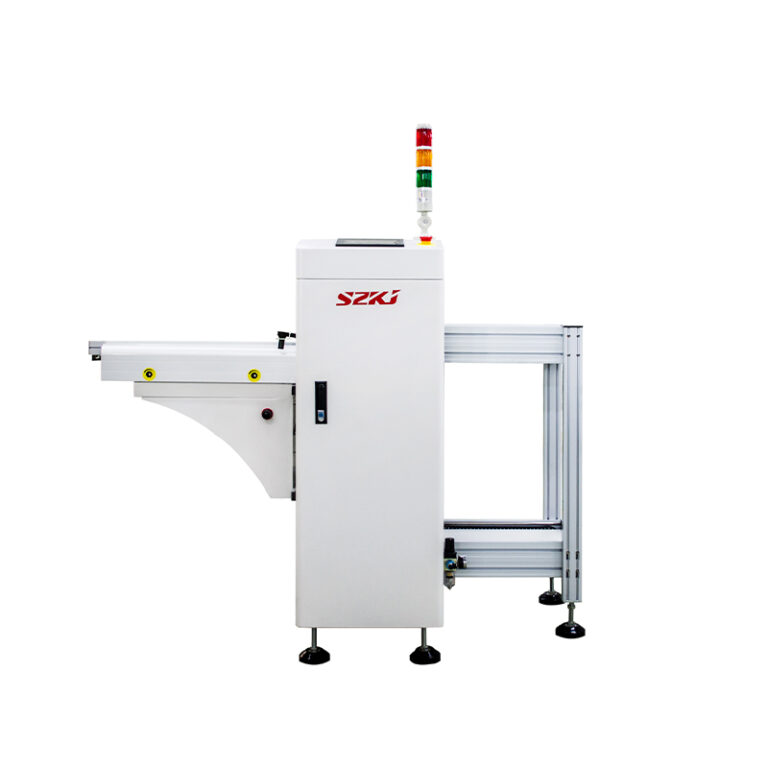
Manufacturing efficiency is among the most important indicators that determine the competitiveness of a company in contemporary manufacturing of electronics manufacturing. SMT PCB Conveyor is among the components of surface-mount technology (SMT) production, and synchronization with ancillary devices makes the high-efficiency, stable production process. Synchronous integration with auxiliary equipment not only raises production speed but also decreases defects and material wastage, making companies competitive.
1. Automated Transport to Reduce Manual Intervention
The benefits of integrating the SMT PCB Conveyor with a PCB Cleaner are:
- Computerized transportation of PCBs from one station to another with minimal manual intervention, minimizing the opportunity for human error, and maintaining minimum production line delay so that the production line can be operated continuously and smoothly.
- Sanitizing the board surface during shipping to clean off dust, grease, and particles which leaves a clean solder pad surface and better solder quality, and less rework.
- Reducing defect potentials due to contamination or operator error, enhancing production efficiency and yield, and stabilizing and making the manufacturing process more reliable.
2. Maintaining Consistent Production Line Pace

The SMT PCB Conveyor works effectively with a Solder Paste Printer in the following ways:
- Proper conveyor speed control to ensure the PCBs move smoothly between placement and printing stages in order to prevent bottlenecks arising from uneven pacing of production or clogging of boards.
- Sustaining an even transfer rhythm that synchronizes solder paste printing with placement in a bid to improve production stability and minimize downtime.
- Supporting long-duration continuous operation so that every PCB reaches the next station at the optimal time, reducing bottlenecks and enhancing overall production efficiency.
3. Adapting to Diverse PCB Specifications
The coordination of the SMT PCB Conveyor with a Pick and Place Machine offers significant advantages:
- Supports various PCB sizes, thicknesses, and shapes, accommodating diverse product types without frequent conveyor adjustments.
- Works with the placement machine to achieve high-speed, precise component placement, even for very small SMD components.
- High-performance models like the DC-250A Dual Rail SMT PCB Conveyor(with light) feature dual-track transport and visual monitoring, enabling operators to track conveyor status in real time, reduce changeover downtime, and improve production flexibility and equipment utilization.
4. Reducing Material Waste and Rework
The SMT PCB Conveyor combined with a Reflow Oven helps:
- Provide continuous PCB alignment before being placed in the oven to prevent vibration/misalignment faults during high-temperature soldering.
- Reduce board damage and soldering defect risks, minimizing rework rates and streamlining manufacturing efficiency.
- Integrate stable conveyance with precise soldering to minimize material waste and enhance overall production line effectiveness, particularly in high-speed continuous manufacturing environments.
5. Data Monitoring and Smart Management
The SMT PCB Conveyor works with AOI/SPI inspection systems to:
- Collect real-time data on PCB transport speed and position using built-in sensors, enabling comprehensive monitoring of each production station.
- Automatically inspect solder paste volume, placement accuracy, and soldering defects, quickly identifying production bottlenecks and abnormalities for timely intervention.
- Provide data-driven feedback to optimize production pacing and workforce allocation, achieving smart management that improves overall efficiency, productivity, and product quality.
Conclusion
The SMT PCB Conveyor is a core component for enhancing production efficiency. When integrated with PCB cleaners, solder paste printers, pick and place machines, reflow ovens, and AOI/SPI inspection systems, solutions from SZKJ enable companies to establish a high-efficiency, stable, and intelligent SMT production line. This collaborative setup not only increases throughput and reduces production costs but also ensures soldering quality and product consistency, strengthening a company’s competitiveness in the electronics manufacturing sector.
Selecting high-performance SMT PCB Conveyors and strategically arranging auxiliary equipment is critical for optimizing production lines and supporting sustainable business growth. To learn more about our solutions, contact us today.

-768x768.jpg)